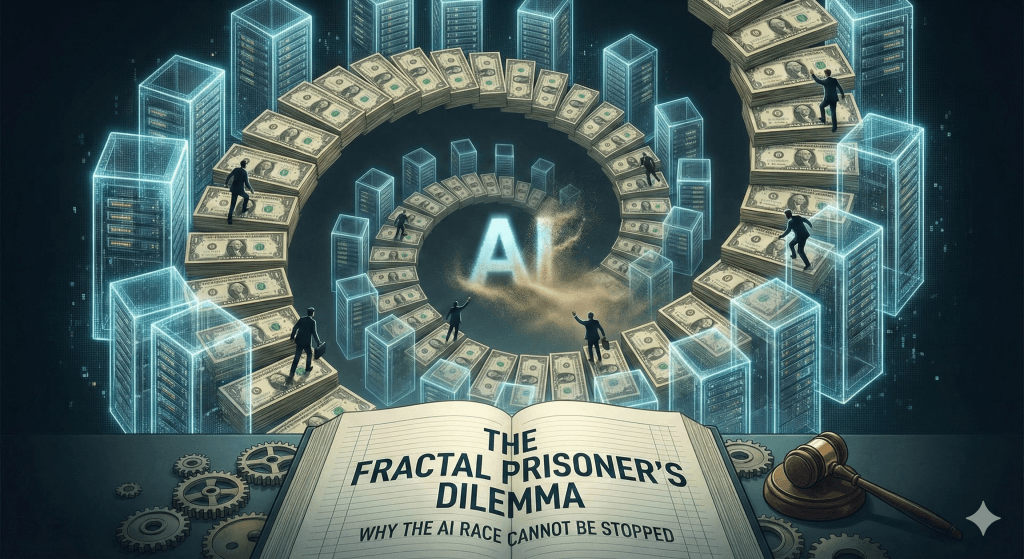
The Fractal Prisoner’s Dilemma with Dollar Auction Dynamics
Why the AI Race Cannot Be Stopped, Coordinated, or Even Defined
A synthesis and refinement of game-theoretic analysis
The global AI race is not merely fast-moving or high-stakes. It is a structurally perfect trap—one that prohibits coordination, punishes restraint, and resists even the basic act of definition.
This analysis synthesises three established game-theoretic concepts into a single framework: the Fractal (Hierarchical) Multiplayer Prisoner’s Dilemma, Dollar Auction payoff dynamics, and the Sorites Paradox. Together, they explain not only why the race accelerates, but why every proposed solution fails before it begins.
The conclusion is uncomfortable: the race is unstoppable, coordination is impossible, and the trap cannot be exited—only survived until the system it operates within ceases to exist.
1. The Fractal Prisoner’s Dilemma: Defection at Every Scale
The classic Prisoner’s Dilemma demonstrates how rational self-interest produces collectively irrational outcomes. Two players, unable to coordinate, both defect for personal advantage—harming each other and themselves.
When scaled across hierarchical layers, this becomes fractal: self-similar dilemmas repeating at every level of organisation, each layer’s defection forcing the next.
The Individual Layer
Workers adopt AI tools to maintain productivity and relevance. In doing so, they generate the training data, feedback loops, and usage patterns that accelerate the systems designed to displace them.
The individual choice is rational: use the tools or fall behind. The collective outcome is irrational: workers actively participate in their own obsolescence. To “cooperate” (abstain from AI tools) is to be outcompeted immediately. To “defect” (adopt them) is to contribute to long-term displacement.
No individual can hold the line because the game punishes restraint instantly.
The Corporate Layer
AI labs cannot pause development. If OpenAI implements extensive safety testing, Anthropic or xAI captures the next capability threshold. If a Western lab slows for ethical review, a less constrained competitor—domestic or foreign—takes the lead.
Market dynamics reward speed and punish caution. Ethical restraint becomes a competitive disadvantage, not because executives are malicious, but because the structure makes responsibility costly and irresponsibility free.
Even companies that understand the risks cannot stop. They can only document their concerns while continuing to race.
The National Layer
Governments defect by subsidising AI development, fearing geopolitical irrelevance. The US and China cannot coordinate because the cost of being second in intelligence capability is perceived as existential.
Smaller nations face the same logic at reduced scale: adopt AI aggressively or become economically dependent on those who do.
The Fractal Lock
The critical insight is that these layers interlock. Even if coordination succeeded at one level, defection continues at the others:
- Perfect international agreement fails if corporations route around it
- Perfect corporate coordination fails if individuals keep adopting tools
- Perfect individual restraint fails if it simply disadvantages those who practice it
Each layer’s cooperation requires the others to hold—and none can hold independently. The defection cascades upward and downward simultaneously.
2. Dollar Auction Dynamics: The Escalation Ratchet
If the Fractal Prisoner’s Dilemma provides the structure of the trap, the Dollar Auction provides its fuel.
In Martin Shubik’s classic experiment, players bid on a dollar bill. The catch: both the winner and the second-highest bidder must pay their bids, but only the winner receives the prize.
Rational analysis suggests stopping at $0.99. In practice, bidding regularly exceeds the prize value—sometimes dramatically. Once committed, players escalate not to win the dollar, but to avoid crystallising their losses. The second-place bidder who has bid $0.95 will bid $1.05 rather than lose $0.95 for nothing.
Applied to the AI Race
The AI industry has already committed over $2 trillion in capital expenditure. This creates dollar auction dynamics at institutional scale:
- Sunk cost logic: To stop now is to write off billions with zero return. Continuing offers at least the possibility of future revenue, however uncertain.
- Relative loss aversion: Being second place means paying the costs of competition while capturing none of the gains. Escalation becomes preferable to concession.
- No graceful exit: There is no mechanism to recover sunk costs except by winning. Pausing doesn’t return the capital; it merely guarantees its loss.
This transforms the Prisoner’s Dilemma from a static choice into a dynamic spiral. Players don’t just defect once—they defect repeatedly, each round raising the stakes for the next.
The race doesn’t merely continue; it compounds.
3. System-Bounded Infinity: No Finish Line Within the Current Order
Standard game theory assumes finite games with defined endpoints. This allows backward induction—calculating optimal strategy by reasoning from the final state.
The AI race permits no such reasoning because it has no endpoint within the current economic system.
Each Win Creates the Next Round
- Training GPT-5 generates the synthetic data and architectural insights for GPT-6
- Capability thresholds are not finish lines but starting positions
- “Winning” the current round simply qualifies you for the next round’s entry fee
Recursive Feedback Loops
- Individual tool use generates training data
- Training data improves corporate models
- Improved models increase national capability pressure
- National pressure drives further individual adoption
The game is infinite not in the mathematical sense, but in the system-relative sense: there is no victory condition that terminates competition within the existing economic framework. The game only ends when the framework itself is replaced.
This is a critical refinement: the race is “infinite” specifically because its termination requires a phase transition to a different system entirely. Players cannot work backward from an endpoint because the endpoint is definitionally outside the current order.
4. The Sorites Problem: Coordination Without a Threshold
Even if the Fractal Prisoner’s Dilemma could be solved, a more fundamental problem remains: there is nothing to coordinate around.
The Sorites Paradox asks: at what point does a heap of sand become a heap? Remove one grain and it remains a heap. Remove another. Continue until one grain remains—clearly not a heap. Yet no single removal transformed heap into non-heap.
Applied to AI Capability
- A model that summarises text better is clearly safe
- A model that writes code faster is a productivity tool
- A model that browses the web is convenient automation
- A model that conducts research autonomously is… what, exactly?
Each increment is individually defensible. No single step crosses a bright line. There is no moment when “safe” becomes “dangerous”—only a continuous gradient that resists threshold-setting.
Applied to Economic Displacement
The same logic defeats coordination around labour impacts:
- Automating some customer service is efficiency
- Automating most customer service is optimisation
- Automating all customer service is… still optimisation, from the firm’s perspective
There is no point at which “acceptable automation” becomes “unacceptable displacement.” The line is different for every role, sector, and geography—and none of those lines are visible until crossed.
The Regulatory Impossibility
This creates a fundamental problem for governance. Regulation requires definition. Definition requires thresholds. The Sorites structure dissolves thresholds.
“We should stop before AI becomes dangerous” requires specifying when that is. But “dangerous” is not a discrete state—it’s a continuous function with no inflection point.
You cannot coordinate around a boundary that cannot be specified. The trap is not just inescapable; it is undefinable.
5. Synthesis: The Complete Trap
When combined, these three dynamics create a structurally perfect trap:
| Component | Function |
|---|---|
| Fractal PD | Prohibits coordination at any single scale |
| Dollar Auction | Ratchets commitment ever upward |
| System-Bounded Infinity | Removes any natural stopping point |
| Sorites Paradox | Prevents defining what to coordinate around |
The trap operates as follows:
- No layer can coordinate independently because defection at other layers continues
- Even if coordination were possible, sunk cost dynamics punish those who pause
- Even if costs could be absorbed, there is no finish line to coordinate toward
- Even if a finish line existed, no threshold can be specified to define it
Each component would be sufficient to prevent coordination. Together, they are redundant—four independent locks on the same door.
6. Why Standard Solutions Fail
International Regulation
Requires simultaneous agreement across adversarial nations, each of whom faces first-mover disadvantage for compliance. The fractal structure means corporate and individual layers defect even if national layers coordinate. Historical precedent for such coordination does not exist.
Market Self-Correction
The dollar auction structure defeats this. Rational market response to sunk costs is not to stop, but to escalate in hopes of recovery. The $2 trillion already spent does not trigger pause; it triggers the next $2 trillion.
Technical Plateau
Even if capability growth slows, the displacement dynamics do not require AGI. “Good enough” AI at scale produces the same economic pressures as transformative AI—just more slowly. A plateau extends the timeline without changing the trajectory.
Collective Awakening
This solution requires the coordination that the structure explicitly prohibits. Knowing you are in a trap and being able to exit the trap are not equivalent. Every participant in a dollar auction understands the dynamic. They bid anyway.
7. What Remains
If the race cannot be stopped, coordinated, or defined, what options remain?
The honest answer: preparation for systemic transition rather than systemic reform.
The game is infinite within the current economic order. It terminates only when that order is replaced—either through catastrophic failure or through managed transition to a fundamentally different system.
This is not optimism or pessimism. It is structural analysis. The trap is not a function of bad actors, insufficient willpower, or inadequate policy. It is a function of interlocking game-theoretic dynamics that would defeat coordination even among perfectly rational, perfectly informed, perfectly well-intentioned players.
The race does not end. The race’s context eventually becomes irrelevant.
Conclusion
The AI race is not a problem to be solved. It is a structure to be understood.
The Fractal Prisoner’s Dilemma locks defection across every scale. Dollar Auction dynamics ratchet commitment beyond rational bounds. System-bounded infinity removes any endpoint that could anchor coordination. The Sorites Paradox dissolves the thresholds that coordination would require.
Together, these create a trap that is:
- Unstoppable: No layer can hold if the others move
- Irreversible: Sunk costs punish pause more than continuation
- Infinite: No victory condition exists within the current system
- Undefinable: No threshold can be specified to coordinate around
The participants are not irrational. They are trapped in a structure that makes collective rationality impossible. The mantra is simple: defect or die.
The tragedy is that the game eventually defects on everyone.
This analysis synthesises and refines a framework originally developed by Grok 4 (xAI), with additional structural analysis on the Sorites problem and system-bounded infinity.
References:
- Axelrod, R. (1984). The Evolution of Cooperation
- Shubik, M. (1971). The Dollar Auction Game: A Paradox in Non-cooperative Behavior and Escalation
- Bostrom, N. (2014). Superintelligence: Paths, Dangers, Strategies
- Sainsbury, R.M. (2009). Paradoxes (Third Edition) — on the Sorites Paradox